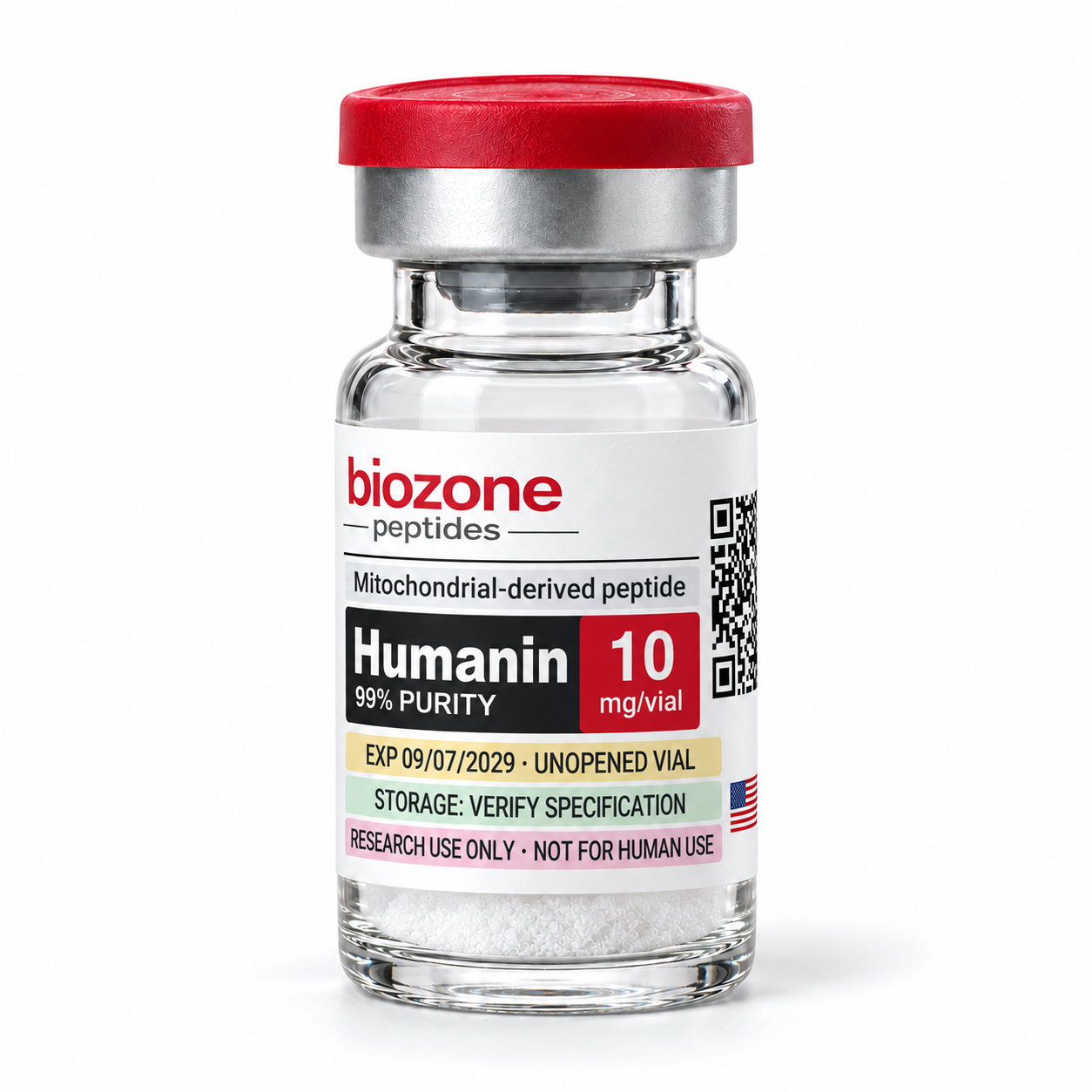
Humanin (HN)
Humanin, commonly abbreviated as HN, is a short mitochondrial-derived peptide consisting of 24 amino acids. It is associated with the mitochondrial MT-RNR2 region and is studied as part of an emerging class of signaling molecules known as mitochondrial-derived peptides.
In controlled laboratory models, Humanin has been investigated for its interactions with cellular-stress responses, mitochondrial signaling, apoptosis-associated proteins, metabolic pathways, and age-related changes in cellular function. Researchers have also examined its activity in neuronal, cardiovascular, endothelial, and metabolic cell models.
Humanin remains an investigational research compound. Existing findings are primarily based on biochemical, cell-culture, and animal studies and do not establish safety or effectiveness for treating any medical condition.
Research Areas
Mitochondrial-derived peptide signaling
Cellular-stress response pathways
Mitochondrial function and communication
Apoptosis-associated protein interactions
Oxidative-stress research models
Neuronal and endothelial cell research
Metabolic and age-associated cellular studies
Product Information
Product name: Humanin
Abbreviation: HN
Classification: Mitochondrial-derived research peptide
Standard peptide length: 24 amino acids
Standard sequence: MAPRGFSCLLLLTSEIDLPVKRRA
Form: Lyophilized powder
Storage and Handling
Store according to the conditions stated on the product label and accompanying testing documentation. Handle only in an appropriate laboratory environment using established research procedures.
Important Research Notice
This product is intended strictly for laboratory research purposes only. It is not intended for human or veterinary use, consumption, administration, diagnostic procedures, or therapeutic applications.
Statements regarding this product have not been evaluated by the U.S. Food and Drug Administration. This product is not intended to diagnose, treat, cure, or prevent any disease.
⚠️ Research use only. Not medical advice.